
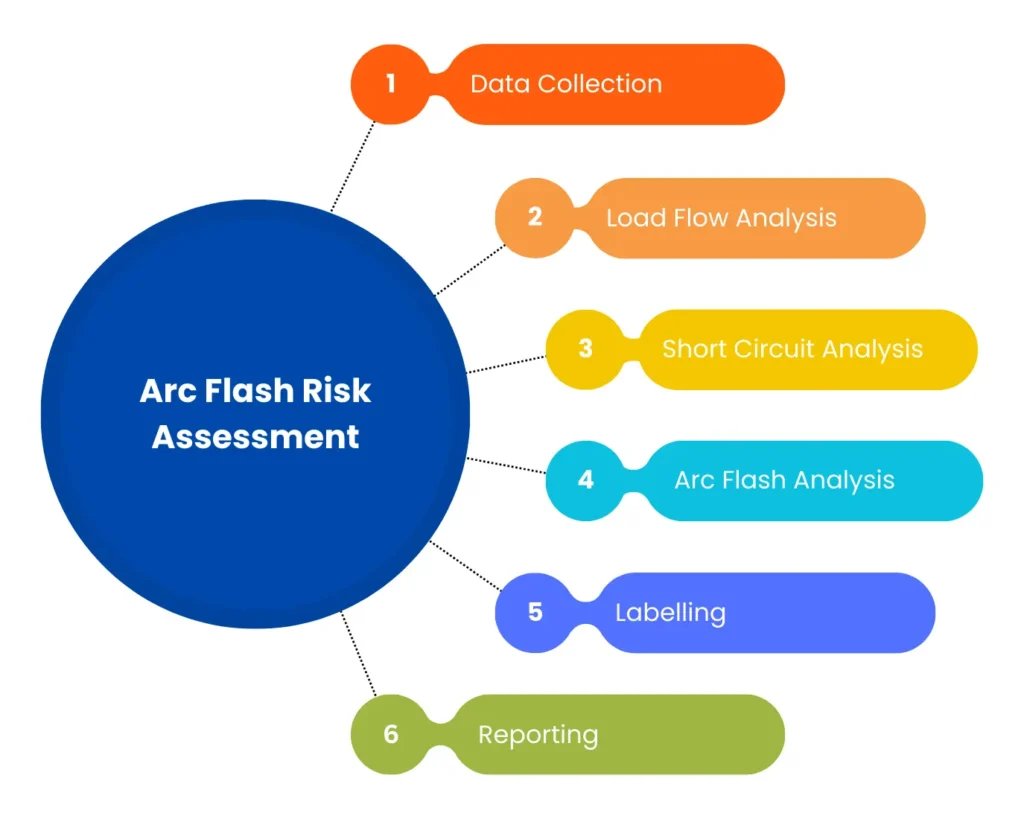
What is Arc Flash Risk Assessment?
An Arc Flash Risk Assessment is a comprehensive evaluation of electrical systems to identify potential arc flash hazards. It involves hazard identification, incident energy calculations, and tailored recommendations to minimize risks and safeguard workers.
Arc flash incidents occur when a low-impedance fault creates an intense electrical explosion, leading to severe injuries, equipment damage, and even fires. At Vedant Energy Solutions, our assessments go beyond routine inspections, delivering practical safety solutions aligned with international standards to ensure a safer workplace.
Why Choose Vedant for Arc Flash Risk Assessment
Summarize your strengths in a succinct, compelling way
ARC Flash Risk Assessment encompasses
Our Arc Flash Risk Assessment services cover a wide range of technical evaluations to identify hazards, calculate risks, and implement protective strategies. Each step ensures compliance with international safety standards while enhancing workplace electrical safety.
✔ Voltage profile analysis for normal & contingency conditions
✔ Observations on power flow patterns
✔ Adequacy check for equipment ratings
✔ System losses determination
✔ Phase current, voltage & phase angle for various faults
✔ Verification of switchgear rupture capacity
✔ Effects of fault current on system components
✔ Assessment of short circuits on system voltage profile
✔ Protective relay settings determination
✔ Recommendations for PPE based on arc flash hazard calculations
✔ Guidance on PPE types and levels for specific work locations and tasks
✔ Results for arcing fault magnitude, clearing time, arc duration
✔ Arc flash boundary and working distance calculations
✔ Recommendations for equipment or system changes
✔ Generation of warning labels for each analyzed work location
✔ Labels include key details: Header & sub-header, Nominal voltage, Arc flash boundary, Incident energy, Working distance, Approach boundaries, and Report details.
✔ Summary of: Fault current calculations, Listing peak, Breaking currents.
✔ Recommendations for replacement or retrofit of over-burdened protective devices.
✔ Strategies to mitigate incident energy levels.
✔ Recommendations for reducing arc flash energy levels below 40 cal/cm².